





info@integrus.org
Inside the Integrus360: Negative Self-Talk
Jeri Bisbee • June 24, 2026

Most leaders know what it feels like to have a thought they can't quite shake.
It may come after a difficult conversation, a missed deadline, a decision that did not land well, or a moment when they walked away wondering if they said too much, too little, or the wrong thing altogether.
For some leaders, the thought is subtle.
"I should have handled that better."
For others, it is more severe.
"I always mess this up. I’m not good at this. They’re going to realize I’m not the right person for this role. I should be further along by now."
For many high-capacity leaders, those messages do not stay isolated to one moment. They repeat. They build. They become a running narrative.
That is why the Negative Self-Talk Dial in the Integrus360 is so important.
At first glance, it may sound like this dial measures something very internal. After all, negative self-talk is the way a leader talks to themselves. But what happens internally rarely stays internal for long. The messages a leader rehearses in their own mind eventually begin to shape how they make decisions, how they recover from mistakes, how they receive feedback, and how confidently they lead the people around them.
In other words, negative self-talk may begin as an internal voice, but over time, it shapes leadership behavior.
What the Negative Self-Talk Dial Measures
The Negative Self-Talk Dial gives insight about the degree to which a leader may be carrying an internal narrative that is harsh, critical, or self-defeating.
One of the unique things about this dial is that it is weighted differently than many of the other dials in the Integrus360. In most areas, the feedback of others carries the greatest weight because leadership is measured by the behaviors people actually experience. But with the Negative Self-Talk Dial, the leader’s own score matters significantly because this activity happens internally.
This is the leader’s inner dialogue:
- What are they saying to themselves when something goes wrong?
- How long does that message keep speaking?
- How loud does that voice become?
- How much space does it take up in their decision-making, confidence, or ability to move forward?
A little self-reflection can be healthy. Leaders should be able to recognize when they have made a mistake, take responsibility, and make needed adjustments. But when reflection turns into rumination, shame, self-abasement, or a constant replaying of failure, it stops producing growth and begins creating drag.
That is when the voice is speaking louder and longer than it should.
When the Voice Gets Too Loud
A leader with high negative self-talk may appear responsible, humble, or deeply committed to doing things well. Often, they are. But beneath the surface, they may also be carrying a constant internal pressure to get everything right.
This can show up in several ways.
- They may overthink decisions because they are afraid of making the wrong call.
- They may replay conversations long after they are over.
- They may hesitate to act because they are trying to avoid another mistake.
- They may struggle to receive feedback without turning it into an indictment of who they are.
- They may use self-deprecating humor in ways that reveal something deeper than a joke.
Sometimes it sounds like:
"I can’t believe I did that. That was so stupid. I should know better. I’m failing at this. Everyone else is handling this better than I am."
Even if those words are never spoken out loud, the effects often become visible.
The leader slows down.
Confidence drops.
Decision-making becomes clouded.
They may get stuck in analysis paralysis, not because they lack vision or ability, but because they are trying to protect themselves from feeling like they failed again.
This is especially important because leadership requires movement. Leaders are constantly making decisions with imperfect information. They are navigating people, pressure, complexity, conflict, and change. If the internal narrative is always accusing, criticizing, or questioning their worth, it becomes difficult to lead from a place of clarity and health.
When the Voice Is Too Quiet
There is another side to this dial as well.
If a leader scores very low in negative self-talk, that can sometimes reveal a different growth opportunity. The question becomes: How much responsibility are they taking when something does go wrong?
Some leaders move so quickly and confidently that they may not pause long enough to own their part. They may be decisive, driven, and action-oriented, but if they rarely reflect on mistakes, they can come across as dismissive or unaware. They may quickly identify where others need to grow while failing to acknowledge the impact of their own behavior.
A healthy leader does not live under constant self-criticism, but they also do not avoid responsibility.
The goal is not to eliminate all self-reflection. The goal is to bring the inner dialogue into a healthy range where a leader can take ownership without attacking their identity.
There is a significant difference between saying, “I made a mistake,” and saying, “I am a mistake.”
One leads to growth. The other leads to shame.
Where Negative Self-Talk Comes From
Negative self-talk often has a history. Sometimes the voice in a leader’s head sounds like a parent, a coach, a former supervisor, a teacher, a pastor, a peer, or a painful failure they never fully processed. Sometimes it comes from:
- Comparison
- Perfectionism.
- Unrealistic expectations they have carried for years
The message may have started as something someone said. It may have even contained a piece of truth.
"You need to improve here."
"You did not handle that well."
"This part of your leadership needs work."
Those statements may be true in a specific situation. But when a leader takes a specific piece of feedback and allows it to become an identity statement, it becomes destructive.
There is a difference between “I need to grow in this area” and “I am not enough.”
There is a difference between “I made the wrong call” and “I cannot be trusted to lead.”
There is a difference between “That conversation did not go well” and “I always ruin things.”
Healthy leaders know how to separate fact from fiction. They can receive correction without surrendering their identity to it.
That distinction matters because the messages we agree with are the messages that begin to shape us.
The Question Every Leader Needs to Ask
One of the most powerful questions a leader can ask when negative self-talk shows up is simple:
"Who told you that?"
That question slows the spiral.
It gives a leader space to stop accepting every thought as truth, and more importantly, piercing their identity. It invites them to examine the source of the message, the accuracy of the message, and the effect of the message.
Who told you that you always fail?
Who told you that one mistake disqualifies you?
Who told you that needing help means you are weak?
Who told you that you have to be perfect to be credible?
Who told you that your value is measured by how well everyone responds to your leadership?
Not every thought deserves agreement.
Some thoughts need to be corrected. Some need to be challenged. Some need to be replaced with truth.
For leaders of faith, this becomes deeply connected to identity. If a thought does not align with what God says is true, it should not be allowed to become the loudest voice in the room. A leader cannot afford to continually rehearse messages about themselves that their Creator does not speak over them.
That does not mean leaders avoid responsibility. It means they take responsibility from a place of truth instead of shame.
Why This Matters for the Team
A leader may believe their negative self-talk is private, but teams often feel the effects.
When stuck in self-criticism, the team may experience their leader delaying decisions, hesitating unnecessarily, over-explaining, withdrawing emotionally, being defensive, or being inconsistent.
The leader may need more reassurance than the team can reasonably provide. They may avoid hard conversations because they are afraid of getting it wrong. They may struggle to move forward after mistakes, causing the team to remain stuck with them.
Leadership always sends a message.
What a leader says sends a message.
What a leader does sends a message.
What a leader avoids sends a message.
What a leader repeatedly models sends a message.
If a leader’s internal narrative is full of accusation, shame, or fear, that narrative will eventually influence the message their leadership sends.
This is why awareness matters so much.
At Integrus, we often say that leaders do not stall because they lack vision. They stall because they lack awareness. Once a leader becomes aware of the messages shaping their behavior, they can begin to interrupt those messages and choose a different way forward.
Reframing the Message
The goal is not simply to stop thinking negatively. Most leaders cannot just tell themselves, “Don’t think that,” and expect the pattern to disappear.
The healthier practice is to notice the thought, name it, examine it, and reframe it with truth.
For example, the negative message may be:
"I always mess this up."
A healthier reframe might be:
"I made a mistake, but I can take responsibility, learn from it, and lead forward."
Or the negative message may be:
"If I get this wrong, I will lose credibility."
A healthier reframe might be:
"Credibility is not built by perfection. It is built by honesty, ownership, consistency, and growth."
This kind of reframing takes practice. Many leaders have repeated the same negative messages for years, and it takes time to build new patterns. But repetition is part of learning. As leaders practice interrupting the old narrative and replacing it with truth, they begin to lead from a healthier internal foundation.
Jeri Bisbee
Executive Coach
Integrus Leadership
A Practical Place to Start
If you recognize that negative self-talk may be shaping the way you lead, start by paying attention.
Do not try to fix every thought at once. Begin by noticing the messages that repeat most often.
- What do you say to yourself when you make a mistake?
- What thought shows up when you receive feedback?
- What message appears when you are under pressure?
- What do you believe about yourself when a decision does not go as planned?
Then ask:
- Is this true?
- Is it fully true or only partially true?
- Have I allowed this to become part of my identity?
- Does this thought lead me toward growth or keep me stuck in shame?
- What is a truer, healthier message I can practice instead?
That is the purpose of The Thought Audit for Leaders.
This free tool was created to help you identify the negative messages repeating in your mind, interrupt the spiral, and reframe those thoughts with truth so they become helpful to your growth instead of harmful to your leadership.
Because the words you repeat internally will eventually shape the way you lead externally.
Download the Thought Audit for Leaders today and begin identifying, interrupting, and reframing the negative messages shaping your leadership.
Ready to See the Full Picture?

How is your inner dialogue shaping the way that you lead?
Negative Self-Talk is one of 12 leadership behavior dials measured in the Integrus360. Each dial includes a score to indicate how you view your leadership, along with up to six anonymous describer scores, giving you unparalleled insight into how your leadership is experienced by others.
Complete your Integrus360 today, and then connect with a behavioral leadership expert to debrief your results and discover which behaviors strengthen your leadership, and more importantly, which behaviors are holding you back.
And if it's been more than 18 months since you last completed your 360, it's time to update your data. Because circumstances change and leaders grow, and your data evolves along with you.
SHARE THIS POST
When Change Hits, Know What to Hold and What to Let Flex Need for Variety hits pretty close to home for me. When I completed my own Integrus360, this was one of those dials where I looked at the results and thought, I don’t know that I love that. Not because the data was wrong. Because I could see it. And once I saw it, I could think of plenty of moments when other people had probably seen it too. Need for Variety can be a little misleading at first. It isn’t measuring whether you like trying new restaurants, rearranging the furniture, or looking for a new adventure every weekend. The Need for Variety dial measures your response to change. When the plan changes, how do you react? When something unexpected gets dropped into your day, what happens in your face, your tone, and your body? When the circumstances you thought you could control suddenly aren’t under your control anymore, what does everybody around you experience? That’s what makes this dial so important for leaders. Change is going to happen. The question is what our behavior communicates when it does. I Like A Good Plan For a lot of my leadership life, I’ve been the guy who appreciates clarity, consistency, systems, and a well-executed plan. Those are good things. At least until I start believing the plan itself is the thing I’m supposed to protect. Years ago, I was helping oversee an event with some well-known worship artists. We had promoted that the event would end at a particular time. Our staff needed to clean the facility afterward and turn everything around for Sunday morning. There was a plan. And then the artists kept playing. And playing. And playing. They were comfortable responding to what was happening in the room—God was doing something special. Meanwhile, I was watching the clock and thinking about the staff waiting to clean, the schedule we had communicated, transportation, overtime, and every other ripple effect. My concerns weren’t imaginary. Those things really mattered. But my initial reaction also showed me something about myself. My instinct was to grab harder for structure because the circumstances had changed and now required a change to the plan. I eventually had to recognize that I could address the legitimate consequences without requiring everything to happen exactly the way I had pictured it. I needed to help our team adapt while still bringing enough structure to the situation to serve people well. That distinction has become really important to me. Both Ends of the Dial Bring Something Valuable There is nothing inherently wrong with a lower Need for Variety. Just like there is nothing inherently wrong with a higher Need for Variety. A leader with a lower Need for Variety can bring consistency, discipline, thoughtful processing, and the ability to protect a good system from being abandoned too quickly. A leader with a higher Need for Variety may bring curiosity, innovation, momentum, and the ability to see opportunity when everyone else is staring at the disruption. We need both. The challenge comes when our natural response becomes our only response. When pressure increases, a leader who naturally wants structure may dig in. We start asking, “What’s the policy? What’s the procedure? What did we already decide?” Sometimes that’s exactly the question that needs to be asked. But sometimes what we are really saying is, “Please make this feel predictable again.” On the other side of this dial, a leader who is energized by change can see the same disruption and immediately think, “New world. New opportunity. Let’s go.” That can be catalytic. It can also cause a team to abandon useful processes, move before people are ready, or continually chase the next idea without executing the last one well. The goal isn’t to become a person who always embraces change. And it isn’t to become a person who always protects the plan. The goal is to learn the appropriate balance between rigidity and flexibility is for each situation. The Question Isn’t Simply, “Should We Change?” I think leaders often get themselves into trouble because we treat an entire decision as though it belongs in one bucket. It's wither "We can’t change this” or "Everything is on the table.” But most real leadership decisions are more complicated than that. There are usually parts of the decision that absolutely need to remain fixed, there are parts we feel strongly about but could change, and then there are probably some details that don’t deserve nearly as much of our energy as we’re giving them. That’s why it's not helpful to ask questions like: What was the original plan? What do I prefer? What worked last time? The more useful que stions we can learn to ask are: What actually needs to remain true? What are my "wants" that are not critical to the mission? What will ultimately make no serious impact on the outcome? These questions help us start separating principles from preferences. What is actually non-negotiable? Some things deserve a firm grip: your mission, your values, safety, and integrity. Some financial boundaries matter. Some commitments matter. Sometimes a deadline really is a deadline. Healthy flexibility does not mean treating everything like it is optional. In fact, leaders with a naturally high Need for Variety may need to be especially deliberate here. Because when a new opportunity appears, it can be easy to become excited about what could happen without first asking what must remain true. One leader I coached is naturally much more comfortable acting first. When his organization needed a new facility, he had an opportunity to grow his leadership. He believed wholeheartedly that he could have found a building he liked and simply said, “We’ll figure out how to make it work.” Instead, he slowed the process down. He brought other people around a whiteboard. He invited feedback. He let them help him process several possibilities before he made the decision. Together, they decided what was nonnegotiable and what was flexible. He didn’t stop being an innovative, action-oriented leader. He added enough structure to his strength of flexibility that his team could trust where he was taking them. But Is It Essential—or Do I Just Really Like It? This is probably the area where those of us who have a lower need for variety get tripped up and have some work to do. There is a big difference between a principle (nonnegotiable) and a preference (flexible). And if we don't slow down enough to really consider the decision, preferences have a funny way of becoming policies. We have a preferred process. A preferred timeline. A preferred vendor. A preferred way of running the meeting. A preferred order for how things should happen. Maybe it really is the best option. But is it essential? That question can be uncomfortable because familiarity often feels a lot like wisdom. Sometimes we have done something the same way for years because it really is a great system. Sometimes we have done it that way for years because...we have done it that way for years. Those aren't the same thing. Preferences are things that matter—they may even be important—but changing them would not prevent us from accomplishing the real purpose of the decision. For a lower Need for Variety leader, this may be the most important category on the page because it gives us somewhere to put the things we care about without pretending they are untouchable. If that's you, this is an area where you can earn great credibility and influence with your team by conceding and letting them own some of these decisions. Some things really can flex Then there are the details where more than one healthy answer exists. The decision can be delegated. The process can change. The original plan can be tested and adjusted. Someone closer to the work might actually have a better idea. Circumstances may have changed enough that the plan we created six months ago is no longer the best path forward. Flexibility doesn’t mean those details are meaningless. It simply means we don’t have to control every one of them to protect the outcome. I once coached a production leader whose instinct was similar to mine. When something disrupted the plan, you could see the tension. But he also had experience doing improv comedy. So I reminded him of one of the basic disciplines of improv: receive what has been given to you before you shut it down. Instead of immediately listing the reasons the unexpected change couldn’t work, he stepped into flexibility first. The unexpected thing happened. He received it. Then he worked with what was actually in front of him. His environment became less stressful, and he became a better teammate—not because he stopped caring about excellent execution, but because he stopped needing every detail to stay under his control. Your team feels your response to change This is ultimately why Need for Variety matters: it affects trust. If my behavior is constantly unpredictable, my team eventually learns to wait before buying into anything. They don't know whether today's direction will still be the direction next week. On the other hand, if every change has to fight its way through my resistance, the team learns something, too. They may stop bringing ideas. They may become reluctant to raise opportunities. They may conclude that changing a plan simply requires too much energy. That kind of rigidity becomes its own form of organizational red tape. Healthy leadership requires us to flex. The higher you move in leadership, the more likely it is that two situations in the same day will require very different responses from you. One decision may require you to protect the boundary. The next may require you to get out of the way. The skill is knowing which is which. Shawn Maurer Executive Coach Integrus Leadership Hold firmly to what matters. Hold loosely to what doesn’t. That's why we created The Change Decision Filter . It's a simple tool designed to help you take a current decision, change, problem, or opportunity and sort its individual pieces into three categories: Non-Negotiable: What must remain true? Preferable: What would I like to preserve? Flexible: What can change? The goal isn't to convince you to embrace more change or resist more change. It's to help you bring the right amount of structure to the decision in front of you. Sometimes leadership requires a firm grip, and sometimes the healthiest thing you can do is loosen it. Download The Change Decision Filter and use it with a decision you're facing right now. You may discover that some of the things you've been protecting aren't actually the things that matter most.

Your team may not need more structure. They may need more clarity. Some leaders love a plan. They want the agenda before the meeting. They think through the details. They establish a process, set a deadline, and make sure everyone knows what happens next. Other leaders are more comfortable figuring things out as they go. They see possibilities quickly. They adapt. They pivot. They may have three new ideas before everyone else has finished processing the first one. Neither approach is automatically healthy—or unhealthy. What matters is what your team experiences on the other side of your leadership. That is why one of the 12 leadership behaviors measured by the Integrus360 is Need for Structure : a leader’s natural need for organization, planning, and structure in their day-to-day work. Used appropriately, structure creates clarity. But like every behavior measured by the Integrus360, a strength that is overused or underused can become a constraint. And when Need for Structure becomes a constraint, your team usually feels it long before you do. When Structure Becomes the Bottleneck I recently debriefed a leader on her Integrus360 results. She had a higher Need for Structure score, but I didn't need to see her results to know that. Her behaviors and background told the story: She showed up to our call a few minutes early. She did her homework and came prepared. She had also built a career around strong planning, organization, determination, and follow-through. Those are real strengths. Then we looked at the team data. The very behaviors this leader was proud of had become so rigid that her team felt suffocated. Instead of creating momentum, she had become a bottleneck. People were hesitant to bring new ideas forward, creativity had stalled, and too many decisions depended on the leader. I knew exactly how this leader felt when she realized that her team wasn't experiencing her leadership the way she intended. As a former CFO, my own high Need for Structure had served me well in an environment filled with regulations, standards, procedures, and details. But at one point in my career, a team member suggested an improvement to an internal process, and I shut the idea down. The existing process worked. It was familiar. It was orderly. I saw no need to change it. It was only when this team member came to me afterward that I recognized what had happened: I prioritized the "perfection" of the existing process over the possibility of improvement and progress. The process was working, but that did not mean it was the best process. That distinction matters. Healthy structure should help the team do its best work. When preserving the structure becomes more important than improving the work, it's an indicator that a leadership strength has started functioning like a constraint. Too much structure can quietly teach your team: Don't challenge the process. Don't bring me an unfinished idea. Don't experiment. Don't change anything without my approval. Over time, your most creative, out-of-the-box thinkers may stop contributing—or decide they would rather contribute somewhere else. When vision creates confusion The opposite end of the dial creates a different problem. I coached a different leader who was highly visionary and creative. When he saw new opportunities or came up with genuinely good ideas, which happened regularly, he sent them to the team. A new initiative. A new possibility. A new direction. When another good idea arrived, the previous project lost momentum as everyone turned toward the next one. From the leader's perspective, he was sharing vision, but from the team's perspective, the target kept moving. They could not always tell whether a new idea was simply something to consider or whether the leader expected everyone to change direction immediately. Projects began but did not always finish, priorities became harder to distinguish, and confusion and anxiety increased. The solution was surprisingly small. Before sending a significant new idea to the entire team, the leader began running it past a trusted direct report who had stronger instincts around structure and organization. Together they would ask: Where does this fit among our current priorities? Is this something we should act on now or simply continue thinking about? Have we provided enough detail? Who would own it? What would the timeline and desired outcome be? That one change reduced the number of idea-driven emails, gave the team greater clarity, and ultimately helped increase productivity. The leader did not have to stop being visionary. He simply had to add enough structure around his vision for other people to know what to do with it. Clarity Is Not the Same Thing As Control This may be one of the most important distinctions for leaders working on their Need for Structure. Your team needs clarity, but that does not mean they need you to control every detail. Appropriate structure helps people answer basic questions: What are we trying to accomplish? Why does this matter? Where does it fall among our priorities? What is my responsibility? What decisions can I make? What does success look like? When is this due? What happens next? When your team is missing answers to these questions, they have to fill in the gaps themselves. And data shows that we don't often make the right choice. Some will hesitate. Some will move forward and hope they interpreted you correctly. Some will spend unnecessary time seeking approval. Some will work hard on something you never intended to be a priority. Others will simply wait. Creating clarity also requires leaders to communicate where structure ends and space for creativity begins. Your team should know what must remain fixed—the things that can't change—but they should also know what can be flexible and where you are actively inviting them to create, adapt, improve, and solve problems. Healthy structure gives people a path. It does not require the leader to dictate every step along the way. Pressure Makes Your Natural Tendencies Louder Providing the right amount of structure can become even harder when the stakes increase. It doesn't matter if you have a higher or lower score on this dial, pressure tends to amplify a leader's natural Need for Structure. A leader with a higher Need for Structure may respond to pressure by tightening control, wanting more information, requiring more approval, and pausing for more certainty. They might also leave less room to experiment. A leader with a lower Need for Structure may head in the opposite direction: the plan gets abandoned, the team starts improvising, and priorities change in real time. In both cases, the leaders may feel like they are responding appropriately to the moment. But the team may experience something very different. This is why intentional leadership behaviors matter most when the pressure is on. If you find that your team is currently confused or in the middle of chaos or crisis, pause and answer these questions before moving forward: What is still the priority? What outcome are we protecting? Who owns the next step? What has actually changed—and what hasn't? Where can the team adapt without waiting for permission? Answering those questions will create stability without requiring rigidity. You do not need a rigid plan for every possible circumstance, but when circumstances change, your team should know what remains true and where there's flexibility. Laura Gardner Executive Coach Integrus Leadership Create Clarity Without Limiting Creativity Good structure helps people understand what matters, what success looks like, and how to move forward. That is why we created The Project Clarity Framework , a free practical resource designed to help you process a new project, initiative, or team priority before sharing it with your team. The framework walks you through four important leadership responsibilities: Define the direction. Clarify the desired outcome, why it matters, and where the work belongs among your current priorities. Clarify the work. Define the scope, ownership, plan, milestones, deadlines, and what success looks like. Establish the right boundaries. Determine what must remain fixed, what can be flexible, and what is open for the team to design. Invite contribution and maintain clarity. Give your team room to identify obstacles, suggest better approaches, ask for authority or support, and continue receiving clear communication as the work moves forward. Download The Project Clarity Framework and create clearer direction for your team without limiting their creativity. And if your team is already dealing with competing priorities, unclear responsibilities, stalled work, or constantly changing plans, the tool includes a BONUS RESOURCE: The Project Clarity Reset. This bonus resource includes a 20-minute meeting framework to identify the confusion, reestablish the priority, assign ownership, and confirm the path forward.

Learn how Connectedness helps leaders build trust, surface problems sooner, and strengthen team performance through small, consistent moments of connection.
Healthy critique is not criticism. Learn how the Reflex to Critique Dial helps leaders bring clarity, improve outcomes, and coach their teams well.

Encouragement does not equal feckless leadership. It is leadership currency. Discover how trust, influence, and team performance grow when leaders consistently invest in people over projects.

Stress doesn’t stay contained; it shows up in your leadership. Discover how the anxiety you carry shapes your team, and what to do about it.

Leadership effectiveness is often evaluated based on results, strategy, or intelligence. But long before those factors are fully understood, something else is already shaping your influence. Your presence. Before you speak in a meeting, before you present a plan, before you attempt to align a team around a goal, people are forming impressions. Research tells us first impressions can form in a matter of seconds; sometimes in less than one. That initial perception may not be perfectly accurate, but it is powerful in that it frames how others interpret everything that follows. That is why the Presence Dial inside the Integrus360 matters so much. Presence is not about charisma. It is not about personality type. And it is certainly not about performance. Presence is the combination of the energy and engagement you bring into a room, and the impact that energy has on others. When calibrated well, presence strengthens your leadership. When misaligned, it can quietly undermine your credibility & influence. When Presence Is Too Low Many leaders assume that if they are competent and committed, their influence will naturally follow. But competence alone does not guarantee credibility in the eyes of others. I have worked with highly intelligent, detail-oriented leaders who consistently scored lower on Presence. These were not weak leaders. They were disciplined. Focused. Task-driven. Their internal commitment was strong. But externally, their energy did not translate. To others, they sometimes appeared disengaged, reserved, or difficult to read. In some cases, team members interpreted their focus as indifference. In others, their lack of visible enthusiasm reduced confidence in their direction. None of that was intentional, yet leadership effectiveness is not determined by intention. It is shaped by perception. Because how others perceive your leadership is their reality. If your energy does not communicate belief, conviction, and engagement, people may hesitate to follow, even if your strategy is sound. Too little presence can limit your influence, not because you lack ability, but because others struggle to experience it. When Presence Is Too High The other end of the dial presents a different risk. Some leaders bring significant energy into a room. They are expressive, enthusiastic, and highly verbal. Their intent is often positive: to motivate, to inspire, to move things forward. But unmanaged presence can become overwhelming. High energy without awareness can dominate conversations. It can unintentionally crowd out quieter voices. It can create a dynamic where others feel talked over rather than invited in. In some cases, excessive enthusiasm can even be perceived as performative rather than authentic. When that happens, trust erodes. Presence is not about taking up space. It is about creating the right kind of space; one where others feel both energized and included. Too much presence can be just as limiting as too little. Presence Under Pressure Like every behavior measured in the Integrus360, your natural presence tendencies intensify under pressure. When stress increases, we do not become different leaders; we become amplified versions of ourselves. And sometimes it's our worst version. If your natural tendency is to withdraw, pressure may cause you to disengage further. Your focus may narrow to tasks and outcomes while relational signals diminish. If your tendency is toward intensity, pressure may elevate that intensity into overdrive. You may speak more quickly, interrupt more often, or push harder than the situation requires. It's not inherently wrong to have a higher or lower natural presence but when unmanaged, both can distort how others experience your leadership when it matters most. Pressure does not create presence problems. It reveals them. The Gap Between Intention and Experience One of the most important insights from the Presence Dial is this: how you believe you show up is not what determines your effectiveness. How others experience you does. You may believe you are passionate. Others may experience you as intense. You may believe you are steady and calm. Others may experience you as disengaged. You may believe you are motivating the team. Others may feel overshadowed. The size of the gap between intention and perception determines whether leadership effectiveness is either strengthened or weakened. Presence can make or break your ability to influence not because it defines who you are, but because it shapes how others respond to you. A Practical Step Forward The goal is not to change your personality. The goal is to align your behaviors so that your presence supports your leadership rather than limiting it. To help you begin that reflection, we created a simple one-page tool called the Presence Self Assessment Tool . It is designed to help you evaluate: The first impression you create The energy you consistently bring into rooms How you show up when the pressure increases Whether your presence invites engagement or restricts it Awareness is always the first step to any effective leadership growth. If presence can either strengthen or weaken your effectiveness, it is worth taking an honest look at how you are showing up. Download the Presence Self Awareness Tool , and evaluate how your presence is impacting your leadership today. Terry

What the Value of Time Dial Measures Leaders don’t stall because they lack vision. They stall because they lack awareness. After eight years of coaching with Integrus, I have seen this pattern play out again and again, especially around the Value of Time dial inside the Integrus 360 behavioral leadership profile. The Value of Time dial measures your internal pace and answers questions like these: How urgent are you? How fast does your internal clock run? Do you naturally push for outcomes, or do you move at a more relational, unhurried tempo? But, Value of Time is about more than productivity. It’s about your behavioral urgency and intensity and how your pace affects your influence, credibility, and the people around you. Some leaders run hot: pedal to the metal, always moving, always thinking about the next benchmark. Others are calm, steady, relational. They create space, don’t rush conversations, and resist artificial pressure. Neither wiring is wrong. Both bring tremendous strengths, but unmanaged, either one can become costly. The question isn’t, “Am I high or low?” The question is, “Is my wiring helping or hurting my team and/or the mission?” When Value of Time Is Low Low Value of Time leaders are often: Relational Creative Calm under pressure Present with people In pastoral care settings, this wiring can be a gift. You don’t want someone flying through a hospital ward like they’re clearing an inbox. But when unmanaged, low Value of Time can create: Vague expectations Missed deadlines Difficulty holding people accountable I started working with a particular senior leader who was drowning. They were running from fire to fire, doing work they could do but shouldn’t be doing, and all the while believing they had a high Value of Time because they were solving problems and tackling important issues. But, their Integrus360 data said otherwise. We worked together to identify the behaviors contributing to his overwhelm, aligning them and their team to ensure everyone spent their time on their highest-impact work. And everything changed. Months later, that leader texted: “I’m living my best leadership life.” Today, their team is thriving, benchmarks are being exceeded, and the mission is accelerating. Not because that leader's personality changed, but because they chose different behaviors. When Value of Time Is High On the other end of the spectrum, High Value of Time leaders: See the win quickly Push for outcomes Expect urgency Hate inefficiency Without leaders wired this way, innovation would stall (Electricity might not exist!), and organizations would drift. But again, unmanaged strengths can become constraints, and Value of Time that's too high can create: Chronic frustration Unrealistic timelines Team anxiety High turnover Another leader I had the privilege of working with had an urgency that was crushing their team. Turnover was high, expectations were unclear, and their team felt like nothing was ever enough. The leader wasn’t malicious. They were just moving so fast they forgot to make sure their team was keeping up with them. They assumed everyone else was wired like them and saw what they saw. They didn’t. After hearing about the challenges they faced in their leadership, I asked for their permission to be a truth-teller. "Of course!" they said. I was kind but direct, and told this leader, “You’re the problem. But the good news is you’re also part of the solution.” That was a turning point in their leadership. It didn't happen overnight, in fact it took months to experience the full effect of his intentionality, but this leader adjusted their leadership behavior and saw a significant decrease in his team's frustration and anxiety. In fact, turnover dropped by 90%! Same wiring, healthy leadership behaviors. Pressure Reveals Your Default Under pressure, we don’t become someone new; our leadership behaviors are exaggerated. Leaders tend to revert to their default when the pressure is on, even if we have done the work to manage their constraints into healthy behaviors. Low Value of Time leaders may slow down and get stuck when stress rises. Sometimes their default is to stay busy doing anything instead of making sure they're doing the most important things. In contrast, when pressure rises around High Value of Time leaders, they may accelerate urgency and intensity, leaving their team behind, or worse, destroying their team in pursuit of accomplishing the mission. An unhealthy Value of Time doesn’t just affect productivity. It affects morale. Retention. Credibility. And ultimately, the mission. Most leaders don’t realize how their behavior shifts when stress rises. Even after reading this, many leaders might assume this doesn't apply to them because every leader has blind spots. We assume we’re steady. We assume we’re clear. We assume we’re consistent. But because pressure has a way of amplifying patterns we don’t always see, we created a simple one-page tool to help you uncover how stress may be shaping your urgency, clarity, communication, and expectations. Download the free Pressure Pattern Map and discover your default pattern under stress. It takes just a few minutes, and the insight could change how you lead the next high-pressure moment and save years of influence. What’s the Cost of Ignoring This? Choosing to ignore leadership constraints is definitely a choice you're free to make. But every decision has a cost/reward ratio, and the cost of ignoring an unhealthy Value of Time far exceeds the rewards. It will cost you personally. It will cost your relationally. It will cost your organization. And at the highest level, it will cost you your mission. Because when you’re overwhelmed and burning out, the mission suffers. If your urgency is driving talent away, the mission suffers. And, if your lack of clarity creates confusion, the mission suffers. Leaders don’t stall because they lack vision. They stall because they lack awareness. If this message resonates with you, it may be time to see what your data says. Complete your Integrus 360 and discover how your behaviors align with high-performing leaders in your field. And if it's been more than 18 months since you have completed your 360, it's time to update your data. Because circumstances change, leaders grow, and your data evolves with you.

This year, I’ve watched more leaders wrestle with pressure, uncertainty, and burnout than ever before. It’s easy to think we’ll find peace once things finally calm down. But that’s not how peace works. Peace doesn’t come when circumstances change. It comes when gratitude changes us. I learned that lesson years ago when God used gratitude to break the grip of anxiety on my life. Since then, I’ve seen how gratitude transforms individuals and entire teams alike. Grateful leaders create grounded cultures, and spread calm instead of chaos; peace instead of pressure. As 2025 wraps up, I’m revisiting that lesson and sharing it again. You can read the full story and download a free reflection tool to help you close out the year with gratitude and clarity. Read the full post: Gratitude Makes Good Leaders Great Download the free 2025 End of Year Reflection Guide for Leaders Take a few minutes to slow down, look back, and thank God for the ways He’s shown up this year. Gratitude really does make good leaders great.

Leadership isn’t about bravado—it’s about compassion. Empathy in action can transform your influence and impact.

Discover our top 5 YouVersion Bible App reading plans to grow in faith and leadership, plus a next step resource from our new book Easy to Follow.

Managing tasks is not the same as mentoring leaders. Learn why mentorship shapes who you become, multiplies impact, and transforms your leadership.

When is the last time you revisited your mission statement?

What Ashton Jeanty Taught Me About Leadership Grit

If telling worked, why do moms say, "I'm not going to tell you again!"?

Build Stronger Relationships on Your Team with the CARE Tool

This is Lauren's Testimony
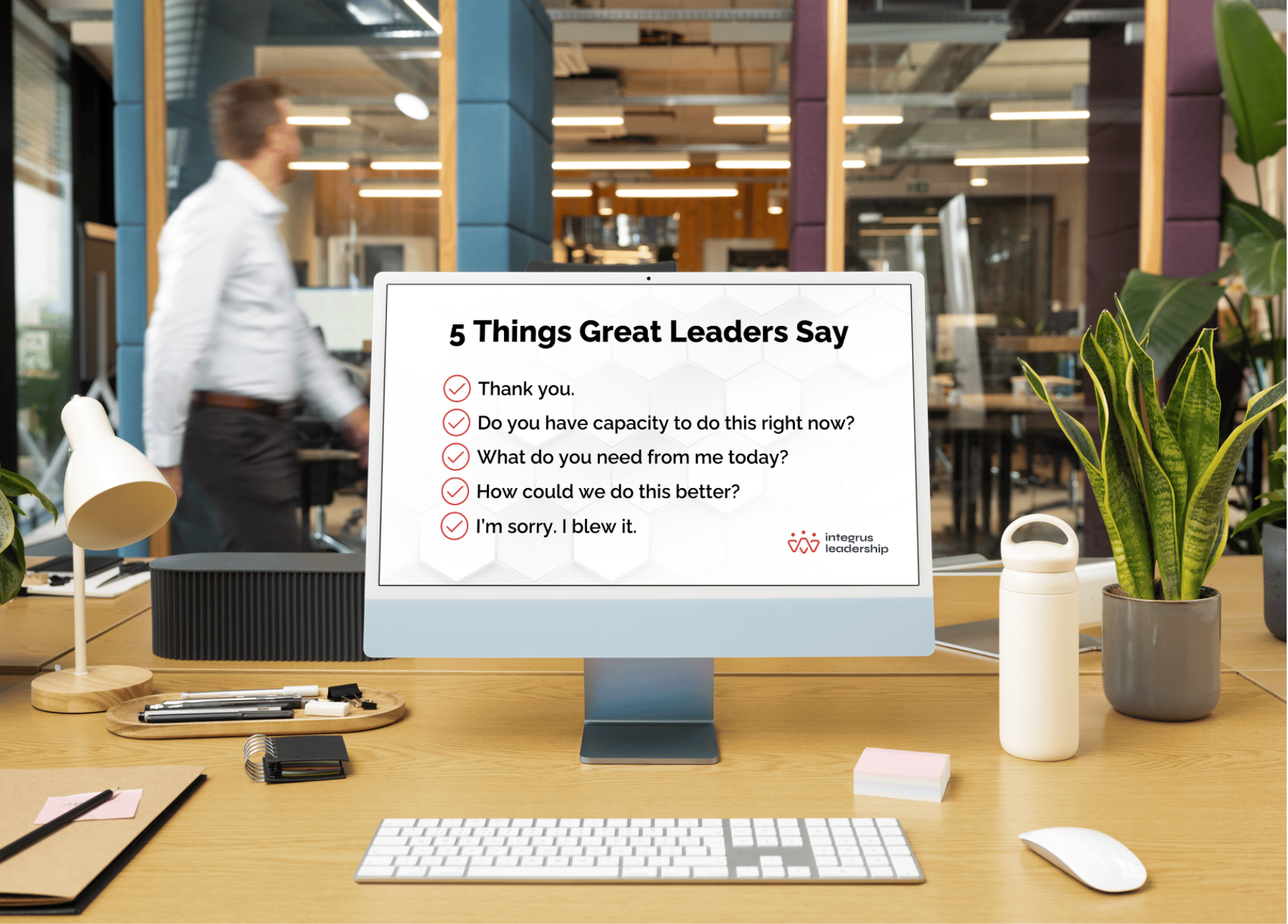
Great leaders know that words have power. The right phrases can build trust, strengthen teams, and create a culture where people thrive. In this post, we share simple yet impactful things great leaders say—and how they make a difference every day.

This blog by Lyle Wells explores key lessons from a former Executive Pastor on how to lead through chaos.

Lyle Wells shares the power of encouragement, teaching leaders how to speak life into others with intentional words. Learn how to uplift, inspire, and build stronger teams through meaningful affirmation and leadership insights. Discover the impact of encouragement today!

At Integrus Leadership, we are passionate about championing organizations whose leaders demonstrate a commitment to excellence and advancing the Kingdom of God. That's why we're highlighting these incredible teams through our Leaders We Love series. Here are four organizations we are thrilled to feature this month.

My prayer life as a leader has had its ups and downs. There are times when: I've prayed timidly, which is surprising because I am not a timid person. I've prayed feeling unworthy, even though I know in my heart that I am worthy to approach the throne of grace with boldness. Sometimes I wonder, "Who am I to ask for this?" I've prayed burdened, feeling the weight of the world's troubles and wondering if my personal requests are even valid. As we kick off a new year and launch our 30 Days of Prayer, I'm curious what your prayer life is like. Are you praying timidly, unworthily, or burdened? Or, are you praying with power, expectancy, and delight? And the harder question: Are you praying for your leadership, at work, or even in the midst of your work? Lately, I've realized that the most powerful leaders in Scripture were devoted to prayer. Hannah, from 1 Samuel 1 is a prime example. Hannah knew: The anguish of infertility. The pain of a broken heart The shame that comes with a body that does not cooperate with your deepest hopes. The mistreatment of a family member. The impact weak spiritual leadership could have in her country. The isolation of suffering in a society driven by evil. The feelings of worthless in a culture that didn’t value her. The confusion of prayers seemingly going unanswered. And yet, Hannah knew how to bring all her struggles to God in prayer.

“Not all readers are leaders, but all leaders are readers.” Harry S. Truman Researchers have analyzed dozens of metrics, and time and time again, the results say the same thing: what separates the good leaders from the great leaders is their commitment to reading. If you want to improve your leadership skills, develop a healthy team, or foster a growth-oriented culture in your organization, start reading leadership books that will help lead yourself, lead a team, or lead an organization. Why Reading Makes Leaders Great Reading expands your viewpoint. In a way, reading books sits you down in front of the author, like a student before the teacher, as they tell you their story and impart their learned knowledge and wisdom. Reading sharpens your problem-solving skills. Julius Caesar is quoted as saying, “experience is the best teacher,” but we disagree; someone else’s experience is the best teacher! When we learn from the wins and losses of those who have gone before us, exposing the problems they have already solved (or not), it helps us analyze information more effectively. Reading fuels creativity and innovation. Books connect us with people who we might otherwise never have the opportunity to learn from, injecting fresh concepts and ideas into stale and stagnant thought patterns. Reading also equips leaders to adapt to change and embrace new strategies because “learning” sits at the core of reading. Reading triggers something inside us that says, “I’m open to new ideas,” readying ourselves for change. Our Staff’s Top Picks The Integrus team has put together a list of our top picks. We’re committed to providing you with insanely practical tools and resources to assist you on your leadership journey, and this list will help you get started on your reading journey to becoming a great leader. We’ve divided the list into 3 categories. These books will help you: lead yourself, lead others, and lead your organization. These books would also make great gifts or stocking stuffers. So, if you’re not sure what to get the leaders in your life for Christmas, this list will give you some ideas. Each of the books on this list have helped our team grow into healthy leaders who make up an effective team, so I am confident they will help you, too. Click the link below to view the 2025 Reading List our website. We’ve creating a page with all of these books linked directly to an online store. Our hope is that this makes it even easier for you to dip your toe in the pool of knowledge that awaits you.

Just days ago, I crossed the finish line of the New York City Marathon, and I’m still riding the high of that experience—medal and all! After eight years of running and five dedicated months of training for this race, I faced unexpected challenges, including a foot injury that nearly sidelined me. These obstacles gave me deeper insights into leadership, lessons I’m excited to share with you. Patience and Persistence Matter Leadership, much like marathon training, is not a sprint. It’s easy to look at leaders and assume that progress is quick and linear, but the reality is often far different. Progress can be slow, non-linear, and full of unexpected twists and turns. During my training, there were days when progress felt almost nonexistent. Yet, those were the moments that mattered most—when I had to push through fatigue, self-doubt, and setbacks. True leaders understand that lasting success comes from staying the course, even when the path forward is uncertain and demanding. Setbacks Are Part of the Journey In both marathons and leadership, setbacks are inevitable. For me, it was a foot injury that flared up weeks before race day. In leadership, it might be unforeseen complications, such as strained resources or processes that don’t go as planned. These challenges can feel discouraging, but great leaders learn to pivot, adapt, and find creative solutions. Setbacks build resilience, and this resilience becomes the fuel that propels you toward future triumphs. Each challenge I overcame during my training helped me build mental and physical endurance for race day—and the same is true for leadership. Celebrate the Small Wins Marathons are long, and reaching each mile marker brings its own sense of achievement. Passing the 5-mile mark, reaching the halfway point, and finally seeing the finish line were moments I celebrated, even if just with a mental cheer. The same principle applies to leadership: every milestone, no matter how small, deserves recognition. These moments of celebration keep your team motivated and energized. They remind everyone that progress is happening, and that acknowledgment helps sustain the team’s drive toward bigger goals. As a leader, it’s essential to create an environment where small wins are appreciated and celebrated. While I know some of you, like my friend Kat, may joke that you'd only run if someone were chasing you, the lessons I took from the NYC Marathon extend far beyond running. I hope these insights inspire you to lead with patience, embrace resilience during challenges, and find joy in celebrating progress—whether you’re striving to complete a major organizational project or pursuing personal growth. Leadership, like marathon training, is a journey that tests us in countless ways, but the lessons along the way make all the difference. Keep pushing forward, celebrate the journey, and know that each step takes you closer to your finish line.

Discover how gratitude can replace fear and anxiety with peace. Thankful leaders inspire calm, clarity, and confidence. Download our End-of-Year Reflection Guide.

As someone who played baseball for over 20 years, I learned a lot about leadership. Baseball is more than just a game—it’s a powerful teacher. Here are my top 10 leadership lessons from the sport that has shaped how I lead today: 1️⃣ You have to be a little crazy if you want to be great. To be exceptional, you’ve got to push boundaries. Just like the best baseball players, great leaders aren’t afraid to take risks and step outside their comfort zones. They embrace challenges with passion and tenacity, even when it seems a bit "crazy" to others. 2️⃣ Success doesn’t come often, so when it does, celebrate it. Baseball is a game of failure—players fail more than they succeed, so when success comes, take the time to celebrate it. The same goes for leadership. Take time to acknowledge the wins, no matter how small they may seem. Celebrating success fuels motivation for the next challenge. 3️⃣ Failure is inevitable, but don’t settle for it—rise above your setbacks. Just because failure happens doesn’t mean we have to accept it or settle for it. Baseball taught me that while failure is frequent, it's also an opportunity for growth. As leaders, we should learn from setbacks, rise above them, and never get comfortable with mediocrity. 4️⃣ Failure isn’t just a step on the path to success; it’s a foundational building block. In baseball, failure is part of the process. The best players use their mistakes to improve. Similarly, failure is essential in leadership. It's not just a stepping stone—it’s the foundation that builds resilience, adaptability, and eventual success. 5️⃣ You have to hate losing way more than you love winning. The drive to avoid failure can often be stronger than the desire to win. Great leaders, like great athletes, are deeply competitive. It’s not just about wanting to win—it’s about refusing to lose. This competitive spirit fuels growth and perseverance. 6️⃣ Not every at-bat needs to be a home run—sometimes, singles are exactly what you need. In today’s culture, we often glorify the "home runs"—the big wins and flashy successes. But in baseball, as in leadership, consistency matters. Sometimes, small wins are just as important. You don’t need to hit it out of the park every time; a well-placed single is what gets the job done. 7️⃣ Isolation is not an option—you can’t play all the positions. In baseball, teamwork is essential. No one can play all nine positions. The same is true in leadership. You need to trust your team and rely on their strengths. Isolation leads to burnout, while collaboration leads to success. 8️⃣ Playing with fear means playing with failure. When you let fear control you, failure follows. On the field and in leadership, playing timidly often leads to errors. Leaders must act with confidence and courage, even in uncertain circumstances. 9️⃣ Sometimes you do everything right and still lose; sometimes you do everything wrong and still win. Baseball, like life, is unpredictable. You can make all the right moves and still not get the result you want. Conversely, you might make mistakes and still come out on top. The key is to learn from every experience and keep improving, regardless of the outcome. 🔟 Numbers can be more distracting than helpful. In baseball, players can get caught up in stats—batting averages, home runs, RBIs. But focusing too much on numbers can distract from the bigger picture. In leadership, metrics are important, but they don’t tell the whole story. Focus on progress and improvement, not just the numbers. Keys to Successful Leadership Awareness Brings Confidence and Clarity One of the biggest lessons from baseball is the importance of awareness. Players who know where everyone is on the field and understand each person’s role play with confidence and freedom. The same applies to leadership. When you have clarity about your team’s roles and responsibilities, you create an environment where everyone can thrive. Be Ready to Pivot In baseball, you never know when you’ll be asked to play a different position. It’s important to be adaptable and ready to pivot when needed. As leaders, we should develop the ability to pivot quickly, adjusting our strategies when circumstances change. Don’t Settle for Failure Just because failure happens often in baseball doesn’t mean you have to like it. Many players use the sport's inherent difficulty as an excuse, but I believe we should hate losing. The competitive spirit should motivate us to work harder and be better every day. Celebrate Success Lastly, don’t forget to celebrate your wins. In ministry and leadership, we can get so caught up in what’s not working that we overlook the good things happening. Take time to acknowledge the positive outcomes, and let that fuel your drive to keep moving forward. Final Thoughts Leadership is like baseball—there’s always room to grow, always something to learn, and always a reason to keep striving. Whether you’re celebrating small wins or learning from failures, the key is to stay focused, stay humble, and keep pushing forward. Remember, success may not come often, but when it does, it’s worth celebrating.
At Integrus, we’re committed to supporting female leaders. We recently hosted a free webinar with two of our behavioral leadership experts to answer the questions female leaders were asking. Our team has distilled that conversation to create the following content, complete with their greatest insights and coaching tips specifically for supporting female leaders.

One Leader's Story of Leading Through Their Hardest Year Yet

Adam Hatton

Vacations don't cure exhaustion. You are mission-critical to your organization, that's why we're passionate about helping leaders practice sustainable work-life rhythms that support healthy relationships and leadership vitality. Here are 5 early signs of burnout.

Let me ask you, what are the non-negotiable behaviors in your organization? Have you defined them, and clarified them the way Jesus has? Let me offer three potential non-negotiables your team could adopt.

Lyle Wells President

Lyle Wells President

Lyle Wells President

Brent Monogue Director of Strategic Engagement

Developing team chemistry by intentionally building relationships is crucial for success.

Reduce risk, improve the health of your culture, and set your team up for success!

Have you ever preached an entire message with your fly-down? I have. It was worse than it sounded. We were about eight weeks into a new church launch and meeting in a movie theater. The stage was dark because we had zero budget for equipment, so our cost-effective solution was to shine the stark spotlights on me and my unzipped zipper. The metal teeth of the zipper were sparkling in the bright lights for 25 minutes before my message concluded. I was the last to know what everyone else had already noticed. Even though my message was Christ-focused and well-delivered, only one thing mattered, the awareness of my issues. My zipper problem would have been easy to fix if I’d been aware. I share my embarrassing moment with you because I think it illustrates what you and I know to be true about leadership coaching. People around us can see our constraints before we do, and a great leadership coach is an effective way to grow in leadership–– they are empowered to bring attention to our constraints. You and I are not doing ministry in a vacuum, your ministry has a culture. It might be unnoticed, but it's fully realized. Your ministry culture involves how you lead, how your teams interact with each other, how you handle conflict, and how everyone communicates with each other. Combine all those organizational elements and you have a culture in which you’re immersed. One you might not even notice. After years of vocational ministry as a church planter and lead pastor, I’ve benefited from a leadership coach. So much so, I’m coaching ministry leaders myself because the tools I’ve learned catalyzed our church for greater impact.

Greatness demands intentionality. Ministry has always been challenging, but these past few years have been the hardest for many of us. Becoming the leader God called you to be will require more intentionality because of the significant challenges ahead of you and your teams. Here at Integrus we engage daily with top-level ministry leaders who are experiencing: Extreme fatigue Burn out Harsh criticism Polarizing divisions Lack of encouragement

Have you ever felt overwhelmed and underresourced as a ministry leader?

Leadership is a behavior that influences others and drives outcomes. A biblical example of someone who influenced those around him and drove outcomes is Nehemiah. He had a task in front of him in that the walls around Jerusalem were down. Nehemiah could have sulked about this, but he chose to influence those around him which yielded an outcome of the walls being rebuilt.

