





info@integrus.org
March 7, 2026
Inside the Integrus360: The Presence Dial

By Terry Cargill
Leadership effectiveness is often evaluated based on results, strategy, or intelligence. But long before those factors are fully understood, something else is already shaping your influence.
Your presence.
Before you speak in a meeting, before you present a plan, before you attempt to align a team around a goal, people are forming impressions. Research tells us first impressions can form in a matter of seconds; sometimes in less than one. That initial perception may not be perfectly accurate, but it is powerful in that it frames how others interpret everything that follows.
That is why the Presence Dial inside the Integrus360 matters so much.
Presence is not about charisma. It is not about personality type. And it is certainly not about performance. Presence is the combination of the energy and engagement you bring into a room, and the impact that energy has on others.
When calibrated well, presence strengthens your leadership. When misaligned, it can quietly undermine your credibility & influence.
When Presence Is Too Low
Many leaders assume that if they are competent and committed, their influence will naturally follow. But competence alone does not guarantee credibility in the eyes of others.
I have worked with highly intelligent, detail-oriented leaders who consistently scored lower on Presence. These were not weak leaders. They were disciplined. Focused. Task-driven. Their internal commitment was strong.
But externally, their energy did not translate.
To others, they sometimes appeared disengaged, reserved, or difficult to read. In some cases, team members interpreted their focus as indifference. In others, their lack of visible enthusiasm reduced confidence in their direction.
None of that was intentional, yet leadership effectiveness is not determined by intention. It is shaped by perception. Because how others perceive your leadership is their reality.
If your energy does not communicate belief, conviction, and engagement, people may hesitate to follow, even if your strategy is sound.
Too little presence can limit your influence, not because you lack ability, but because others struggle to experience it.
When Presence Is Too High
The other end of the dial presents a different risk.
Some leaders bring significant energy into a room. They are expressive, enthusiastic, and highly verbal. Their intent is often positive: to motivate, to inspire, to move things forward.
But unmanaged presence can become overwhelming.
High energy without awareness can dominate conversations. It can unintentionally crowd out quieter voices. It can create a dynamic where others feel talked over rather than invited in.
In some cases, excessive enthusiasm can even be perceived as performative rather than authentic.
When that happens, trust erodes.
Presence is not about taking up space. It is about creating the right kind of space; one where others feel both energized and included.
Too much presence can be just as limiting as too little.
Presence Under Pressure
Like every behavior measured in the Integrus360, your natural presence tendencies intensify under pressure.
When stress increases, we do not become different leaders; we become amplified versions of ourselves. And sometimes it's our worst version.
If your natural tendency is to withdraw, pressure may cause you to disengage further. Your focus may narrow to tasks and outcomes while relational signals diminish.
If your tendency is toward intensity, pressure may elevate that intensity into overdrive. You may speak more quickly, interrupt more often, or push harder than the situation requires.
It's not inherently wrong to have a higher or lower natural presence but when unmanaged, both can distort how others experience your leadership when it matters most.
Pressure does not create presence problems. It reveals them.
The Gap Between Intention and Experience
One of the most important insights from the Presence Dial is this: how you believe you show up is not what determines your effectiveness. How others experience you does.
- You may believe you are passionate. Others may experience you as intense.
- You may believe you are steady and calm. Others may experience you as disengaged.
- You may believe you are motivating the team. Others may feel overshadowed.
The size of the gap between intention and perception determines whether leadership effectiveness is either strengthened or weakened.
Presence can make or break your ability to influence not because it defines who you are, but because it shapes how others respond to you.
A Practical Step Forward
The goal is not to change your personality. The goal is to align your behaviors so that your presence supports your leadership rather than limiting it.
To help you begin that reflection, we created a simple one-page tool called the Presence Self Assessment Tool. It is designed to help you evaluate:
- The first impression you create
- The energy you consistently bring into rooms
- How you show up when the pressure increases
- Whether your presence invites engagement or restricts it
Awareness is always the first step to any effective leadership growth.
If presence can either strengthen or weaken your effectiveness, it is worth taking an honest look at how you are showing up.
Download the Presence Self Awareness Tool, and evaluate how your presence is impacting your leadership today.
Terry
Ready to See the Full Picture?
You know how your leadership feels from where you're sitting, but but how do others experience your leadership?
Start your Integrus360 and receive helpful, anonymous feedback about how your leadership behaviors are experienced by those you work with the most.
And if it's been more than 18 months since you last completed your 360, it's time to update your data. Because circumstances change and leaders grow, and your data evolves along with you.
SHARE THIS POST

What the Value of Time Dial Measures Leaders don’t stall because they lack vision. They stall because they lack awareness. After eight years of coaching with Integrus, I have seen this pattern play out again and again, especially around the Value of Time dial inside the Integrus 360 behavioral leadership profile. The Value of Time dial measures your internal pace and answers questions like these: How urgent are you? How fast does your internal clock run? Do you naturally push for outcomes, or do you move at a more relational, unhurried tempo? But, Value of Time is about more than productivity. It’s about your behavioral urgency and intensity and how your pace affects your influence, credibility, and the people around you. Some leaders run hot: pedal to the metal, always moving, always thinking about the next benchmark. Others are calm, steady, relational. They create space, don’t rush conversations, and resist artificial pressure. Neither wiring is wrong. Both bring tremendous strengths, but unmanaged, either one can become costly. The question isn’t, “Am I high or low?” The question is, “Is my wiring helping or hurting my team and/or the mission?” When Value of Time Is Low Low Value of Time leaders are often: Relational Creative Calm under pressure Present with people In pastoral care settings, this wiring can be a gift. You don’t want someone flying through a hospital ward like they’re clearing an inbox. But when unmanaged, low Value of Time can create: Vague expectations Missed deadlines Difficulty holding people accountable I started working with a particular senior leader who was drowning. They were running from fire to fire, doing work they could do but shouldn’t be doing, and all the while believing they had a high Value of Time because they were solving problems and tackling important issues. But, their Integrus360 data said otherwise. We worked together to identify the behaviors contributing to his overwhelm, aligning them and their team to ensure everyone spent their time on their highest-impact work. And everything changed. Months later, that leader texted: “I’m living my best leadership life.” Today, their team is thriving, benchmarks are being exceeded, and the mission is accelerating. Not because that leader's personality changed, but because they chose different behaviors. When Value of Time Is High On the other end of the spectrum, High Value of Time leaders: See the win quickly Push for outcomes Expect urgency Hate inefficiency Without leaders wired this way, innovation would stall (Electricity might not exist!), and organizations would drift. But again, unmanaged strengths can become constraints, and Value of Time that's too high can create: Chronic frustration Unrealistic timelines Team anxiety High turnover Another leader I had the privilege of working with had an urgency that was crushing their team. Turnover was high, expectations were unclear, and their team felt like nothing was ever enough. The leader wasn’t malicious. They were just moving so fast they forgot to make sure their team was keeping up with them. They assumed everyone else was wired like them and saw what they saw. They didn’t. After hearing about the challenges they faced in their leadership, I asked for their permission to be a truth-teller. "Of course!" they said. I was kind but direct, and told this leader, “You’re the problem. But the good news is you’re also part of the solution.” That was a turning point in their leadership. It didn't happen overnight, in fact it took months to experience the full effect of his intentionality, but this leader adjusted their leadership behavior and saw a significant decrease in his team's frustration and anxiety. In fact, turnover dropped by 90%! Same wiring, healthy leadership behaviors. Pressure Reveals Your Default Under pressure, we don’t become someone new; our leadership behaviors are exaggerated. Leaders tend to revert to their default when the pressure is on, even if we have done the work to manage their constraints into healthy behaviors. Low Value of Time leaders may slow down and get stuck when stress rises. Sometimes their default is to stay busy doing anything instead of making sure they're doing the most important things. In contrast, when pressure rises around High Value of Time leaders, they may accelerate urgency and intensity, leaving their team behind, or worse, destroying their team in pursuit of accomplishing the mission. An unhealthy Value of Time doesn’t just affect productivity. It affects morale. Retention. Credibility. And ultimately, the mission. Most leaders don’t realize how their behavior shifts when stress rises. Even after reading this, many leaders might assume this doesn't apply to them because every leader has blind spots. We assume we’re steady. We assume we’re clear. We assume we’re consistent. But because pressure has a way of amplifying patterns we don’t always see, we created a simple one-page tool to help you uncover how stress may be shaping your urgency, clarity, communication, and expectations. Download the free Pressure Pattern Map and discover your default pattern under stress. It takes just a few minutes, and the insight could change how you lead the next high-pressure moment and save years of influence. What’s the Cost of Ignoring This? Choosing to ignore leadership constraints is definitely a choice you're free to make. But every decision has a cost/reward ratio, and the cost of ignoring an unhealthy Value of Time far exceeds the rewards. It will cost you personally. It will cost your relationally. It will cost your organization. And at the highest level, it will cost you your mission. Because when you’re overwhelmed and burning out, the mission suffers. If your urgency is driving talent away, the mission suffers. And, if your lack of clarity creates confusion, the mission suffers. Leaders don’t stall because they lack vision. They stall because they lack awareness. If this message resonates with you, it may be time to see what your data says. Complete your Integrus 360 and discover how your behaviors align with high-performing leaders in your field. And if it's been more than 18 months since you have completed your 360, it's time to update your data. Because circumstances change, leaders grow, and your data evolves with you.

This year, I’ve watched more leaders wrestle with pressure, uncertainty, and burnout than ever before. It’s easy to think we’ll find peace once things finally calm down. But that’s not how peace works. Peace doesn’t come when circumstances change. It comes when gratitude changes us. I learned that lesson years ago when God used gratitude to break the grip of anxiety on my life. Since then, I’ve seen how gratitude transforms individuals and entire teams alike. Grateful leaders create grounded cultures, and spread calm instead of chaos; peace instead of pressure. As 2025 wraps up, I’m revisiting that lesson and sharing it again. You can read the full story and download a free reflection tool to help you close out the year with gratitude and clarity. Read the full post: Gratitude Makes Good Leaders Great Download the free 2025 End of Year Reflection Guide for Leaders Take a few minutes to slow down, look back, and thank God for the ways He’s shown up this year. Gratitude really does make good leaders great.

Leadership isn’t about bravado—it’s about compassion. Empathy in action can transform your influence and impact.

Discover our top 5 YouVersion Bible App reading plans to grow in faith and leadership, plus a next step resource from our new book Easy to Follow.

Managing tasks is not the same as mentoring leaders. Learn why mentorship shapes who you become, multiplies impact, and transforms your leadership.

When is the last time you revisited your mission statement?

What Ashton Jeanty Taught Me About Leadership Grit

If telling worked, why do moms say, "I'm not going to tell you again!"?
Build Stronger Relationships on Your Team with the CARE Tool

This is Lauren's Testimony
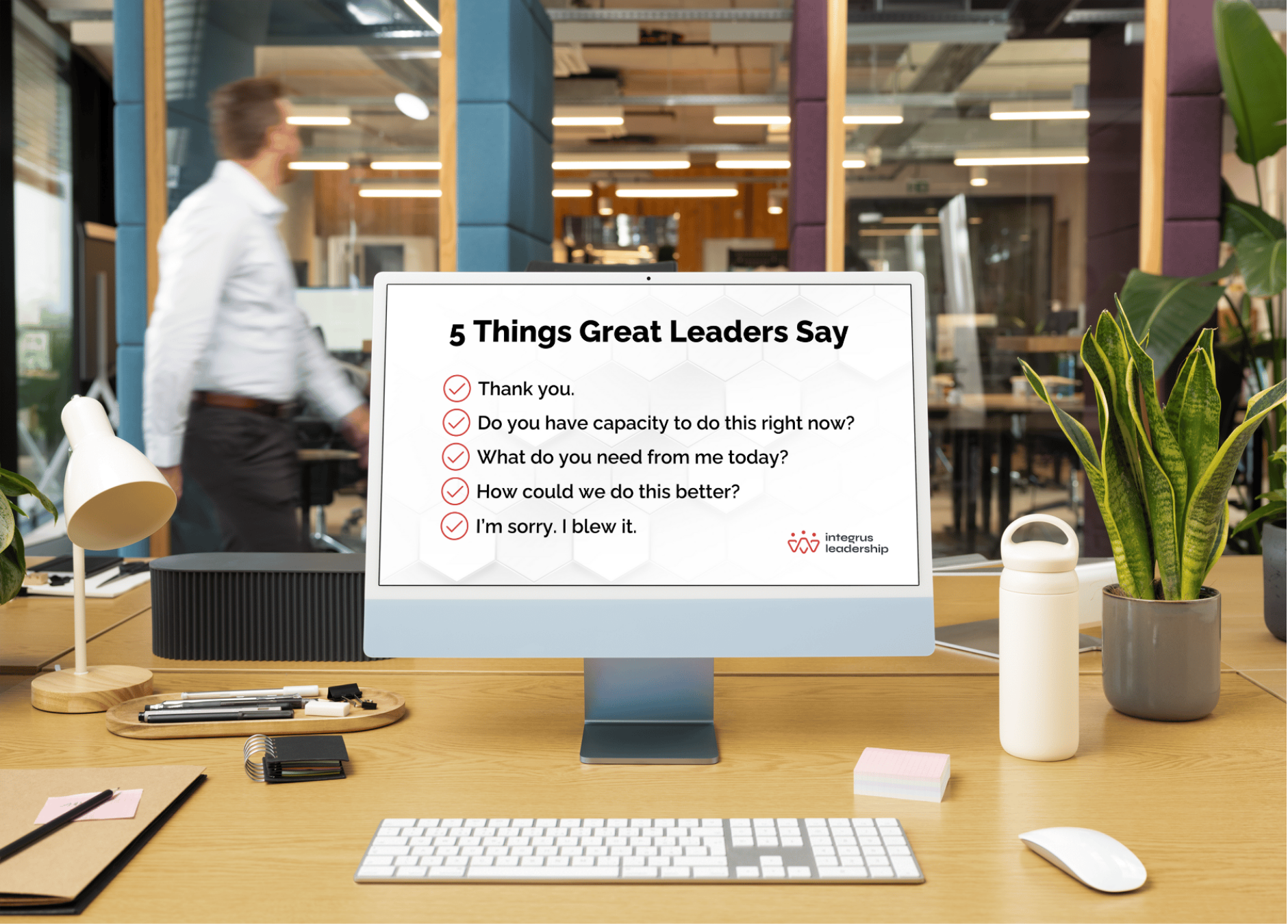
Great leaders know that words have power. The right phrases can build trust, strengthen teams, and create a culture where people thrive. In this post, we share simple yet impactful things great leaders say—and how they make a difference every day.

This blog by Lyle Wells explores key lessons from a former Executive Pastor on how to lead through chaos.

Lyle Wells shares the power of encouragement, teaching leaders how to speak life into others with intentional words. Learn how to uplift, inspire, and build stronger teams through meaningful affirmation and leadership insights. Discover the impact of encouragement today!

At Integrus Leadership, we are passionate about championing organizations whose leaders demonstrate a commitment to excellence and advancing the Kingdom of God. That's why we're highlighting these incredible teams through our Leaders We Love series. Here are four organizations we are thrilled to feature this month.

My prayer life as a leader has had its ups and downs. There are times when: I've prayed timidly, which is surprising because I am not a timid person. I've prayed feeling unworthy, even though I know in my heart that I am worthy to approach the throne of grace with boldness. Sometimes I wonder, "Who am I to ask for this?" I've prayed burdened, feeling the weight of the world's troubles and wondering if my personal requests are even valid. As we kick off a new year and launch our 30 Days of Prayer, I'm curious what your prayer life is like. Are you praying timidly, unworthily, or burdened? Or, are you praying with power, expectancy, and delight? And the harder question: Are you praying for your leadership, at work, or even in the midst of your work? Lately, I've realized that the most powerful leaders in Scripture were devoted to prayer. Hannah, from 1 Samuel 1 is a prime example. Hannah knew: The anguish of infertility. The pain of a broken heart The shame that comes with a body that does not cooperate with your deepest hopes. The mistreatment of a family member. The impact weak spiritual leadership could have in her country. The isolation of suffering in a society driven by evil. The feelings of worthless in a culture that didn’t value her. The confusion of prayers seemingly going unanswered. And yet, Hannah knew how to bring all her struggles to God in prayer.

“Not all readers are leaders, but all leaders are readers.” Harry S. Truman Researchers have analyzed dozens of metrics, and time and time again, the results say the same thing: what separates the good leaders from the great leaders is their commitment to reading. If you want to improve your leadership skills, develop a healthy team, or foster a growth-oriented culture in your organization, start reading leadership books that will help lead yourself, lead a team, or lead an organization. Why Reading Makes Leaders Great Reading expands your viewpoint. In a way, reading books sits you down in front of the author, like a student before the teacher, as they tell you their story and impart their learned knowledge and wisdom. Reading sharpens your problem-solving skills. Julius Caesar is quoted as saying, “experience is the best teacher,” but we disagree; someone else’s experience is the best teacher! When we learn from the wins and losses of those who have gone before us, exposing the problems they have already solved (or not), it helps us analyze information more effectively. Reading fuels creativity and innovation. Books connect us with people who we might otherwise never have the opportunity to learn from, injecting fresh concepts and ideas into stale and stagnant thought patterns. Reading also equips leaders to adapt to change and embrace new strategies because “learning” sits at the core of reading. Reading triggers something inside us that says, “I’m open to new ideas,” readying ourselves for change. Our Staff’s Top Picks The Integrus team has put together a list of our top picks. We’re committed to providing you with insanely practical tools and resources to assist you on your leadership journey, and this list will help you get started on your reading journey to becoming a great leader. We’ve divided the list into 3 categories. These books will help you: lead yourself, lead others, and lead your organization. These books would also make great gifts or stocking stuffers. So, if you’re not sure what to get the leaders in your life for Christmas, this list will give you some ideas. Each of the books on this list have helped our team grow into healthy leaders who make up an effective team, so I am confident they will help you, too. Click the link below to view the 2025 Reading List our website. We’ve creating a page with all of these books linked directly to an online store. Our hope is that this makes it even easier for you to dip your toe in the pool of knowledge that awaits you.

Just days ago, I crossed the finish line of the New York City Marathon, and I’m still riding the high of that experience—medal and all! After eight years of running and five dedicated months of training for this race, I faced unexpected challenges, including a foot injury that nearly sidelined me. These obstacles gave me deeper insights into leadership, lessons I’m excited to share with you. Patience and Persistence Matter Leadership, much like marathon training, is not a sprint. It’s easy to look at leaders and assume that progress is quick and linear, but the reality is often far different. Progress can be slow, non-linear, and full of unexpected twists and turns. During my training, there were days when progress felt almost nonexistent. Yet, those were the moments that mattered most—when I had to push through fatigue, self-doubt, and setbacks. True leaders understand that lasting success comes from staying the course, even when the path forward is uncertain and demanding. Setbacks Are Part of the Journey In both marathons and leadership, setbacks are inevitable. For me, it was a foot injury that flared up weeks before race day. In leadership, it might be unforeseen complications, such as strained resources or processes that don’t go as planned. These challenges can feel discouraging, but great leaders learn to pivot, adapt, and find creative solutions. Setbacks build resilience, and this resilience becomes the fuel that propels you toward future triumphs. Each challenge I overcame during my training helped me build mental and physical endurance for race day—and the same is true for leadership. Celebrate the Small Wins Marathons are long, and reaching each mile marker brings its own sense of achievement. Passing the 5-mile mark, reaching the halfway point, and finally seeing the finish line were moments I celebrated, even if just with a mental cheer. The same principle applies to leadership: every milestone, no matter how small, deserves recognition. These moments of celebration keep your team motivated and energized. They remind everyone that progress is happening, and that acknowledgment helps sustain the team’s drive toward bigger goals. As a leader, it’s essential to create an environment where small wins are appreciated and celebrated. While I know some of you, like my friend Kat, may joke that you'd only run if someone were chasing you, the lessons I took from the NYC Marathon extend far beyond running. I hope these insights inspire you to lead with patience, embrace resilience during challenges, and find joy in celebrating progress—whether you’re striving to complete a major organizational project or pursuing personal growth. Leadership, like marathon training, is a journey that tests us in countless ways, but the lessons along the way make all the difference. Keep pushing forward, celebrate the journey, and know that each step takes you closer to your finish line.

Discover how gratitude can replace fear and anxiety with peace. Thankful leaders inspire calm, clarity, and confidence. Download our End-of-Year Reflection Guide.

As someone who played baseball for over 20 years, I learned a lot about leadership. Baseball is more than just a game—it’s a powerful teacher. Here are my top 10 leadership lessons from the sport that has shaped how I lead today: 1️⃣ You have to be a little crazy if you want to be great. To be exceptional, you’ve got to push boundaries. Just like the best baseball players, great leaders aren’t afraid to take risks and step outside their comfort zones. They embrace challenges with passion and tenacity, even when it seems a bit "crazy" to others. 2️⃣ Success doesn’t come often, so when it does, celebrate it. Baseball is a game of failure—players fail more than they succeed, so when success comes, take the time to celebrate it. The same goes for leadership. Take time to acknowledge the wins, no matter how small they may seem. Celebrating success fuels motivation for the next challenge. 3️⃣ Failure is inevitable, but don’t settle for it—rise above your setbacks. Just because failure happens doesn’t mean we have to accept it or settle for it. Baseball taught me that while failure is frequent, it's also an opportunity for growth. As leaders, we should learn from setbacks, rise above them, and never get comfortable with mediocrity. 4️⃣ Failure isn’t just a step on the path to success; it’s a foundational building block. In baseball, failure is part of the process. The best players use their mistakes to improve. Similarly, failure is essential in leadership. It's not just a stepping stone—it’s the foundation that builds resilience, adaptability, and eventual success. 5️⃣ You have to hate losing way more than you love winning. The drive to avoid failure can often be stronger than the desire to win. Great leaders, like great athletes, are deeply competitive. It’s not just about wanting to win—it’s about refusing to lose. This competitive spirit fuels growth and perseverance. 6️⃣ Not every at-bat needs to be a home run—sometimes, singles are exactly what you need. In today’s culture, we often glorify the "home runs"—the big wins and flashy successes. But in baseball, as in leadership, consistency matters. Sometimes, small wins are just as important. You don’t need to hit it out of the park every time; a well-placed single is what gets the job done. 7️⃣ Isolation is not an option—you can’t play all the positions. In baseball, teamwork is essential. No one can play all nine positions. The same is true in leadership. You need to trust your team and rely on their strengths. Isolation leads to burnout, while collaboration leads to success. 8️⃣ Playing with fear means playing with failure. When you let fear control you, failure follows. On the field and in leadership, playing timidly often leads to errors. Leaders must act with confidence and courage, even in uncertain circumstances. 9️⃣ Sometimes you do everything right and still lose; sometimes you do everything wrong and still win. Baseball, like life, is unpredictable. You can make all the right moves and still not get the result you want. Conversely, you might make mistakes and still come out on top. The key is to learn from every experience and keep improving, regardless of the outcome. 🔟 Numbers can be more distracting than helpful. In baseball, players can get caught up in stats—batting averages, home runs, RBIs. But focusing too much on numbers can distract from the bigger picture. In leadership, metrics are important, but they don’t tell the whole story. Focus on progress and improvement, not just the numbers. Keys to Successful Leadership Awareness Brings Confidence and Clarity One of the biggest lessons from baseball is the importance of awareness. Players who know where everyone is on the field and understand each person’s role play with confidence and freedom. The same applies to leadership. When you have clarity about your team’s roles and responsibilities, you create an environment where everyone can thrive. Be Ready to Pivot In baseball, you never know when you’ll be asked to play a different position. It’s important to be adaptable and ready to pivot when needed. As leaders, we should develop the ability to pivot quickly, adjusting our strategies when circumstances change. Don’t Settle for Failure Just because failure happens often in baseball doesn’t mean you have to like it. Many players use the sport's inherent difficulty as an excuse, but I believe we should hate losing. The competitive spirit should motivate us to work harder and be better every day. Celebrate Success Lastly, don’t forget to celebrate your wins. In ministry and leadership, we can get so caught up in what’s not working that we overlook the good things happening. Take time to acknowledge the positive outcomes, and let that fuel your drive to keep moving forward. Final Thoughts Leadership is like baseball—there’s always room to grow, always something to learn, and always a reason to keep striving. Whether you’re celebrating small wins or learning from failures, the key is to stay focused, stay humble, and keep pushing forward. Remember, success may not come often, but when it does, it’s worth celebrating.

At Integrus, we’re committed to supporting female leaders. We recently hosted a free webinar with two of our behavioral leadership experts to answer the questions female leaders were asking. Our team has distilled that conversation to create the following content, complete with their greatest insights and coaching tips specifically for supporting female leaders.

One Leader's Story of Leading Through Their Hardest Year Yet

Adam Hatton

Vacations don't cure exhaustion. You are mission-critical to your organization, that's why we're passionate about helping leaders practice sustainable work-life rhythms that support healthy relationships and leadership vitality. Here are 5 early signs of burnout.

Let me ask you, what are the non-negotiable behaviors in your organization? Have you defined them, and clarified them the way Jesus has? Let me offer three potential non-negotiables your team could adopt.

Lyle Wells President

Lyle Wells President

Lyle Wells President

Brent Monogue Director of Strategic Engagement

Developing team chemistry by intentionally building relationships is crucial for success.

Reduce risk, improve the health of your culture, and set your team up for success!

Have you ever preached an entire message with your fly-down? I have. It was worse than it sounded. We were about eight weeks into a new church launch and meeting in a movie theater. The stage was dark because we had zero budget for equipment, so our cost-effective solution was to shine the stark spotlights on me and my unzipped zipper. The metal teeth of the zipper were sparkling in the bright lights for 25 minutes before my message concluded. I was the last to know what everyone else had already noticed. Even though my message was Christ-focused and well-delivered, only one thing mattered, the awareness of my issues. My zipper problem would have been easy to fix if I’d been aware. I share my embarrassing moment with you because I think it illustrates what you and I know to be true about leadership coaching. People around us can see our constraints before we do, and a great leadership coach is an effective way to grow in leadership–– they are empowered to bring attention to our constraints. You and I are not doing ministry in a vacuum, your ministry has a culture. It might be unnoticed, but it's fully realized. Your ministry culture involves how you lead, how your teams interact with each other, how you handle conflict, and how everyone communicates with each other. Combine all those organizational elements and you have a culture in which you’re immersed. One you might not even notice. After years of vocational ministry as a church planter and lead pastor, I’ve benefited from a leadership coach. So much so, I’m coaching ministry leaders myself because the tools I’ve learned catalyzed our church for greater impact.

Greatness demands intentionality. Ministry has always been challenging, but these past few years have been the hardest for many of us. Becoming the leader God called you to be will require more intentionality because of the significant challenges ahead of you and your teams. Here at Integrus we engage daily with top-level ministry leaders who are experiencing: Extreme fatigue Burn out Harsh criticism Polarizing divisions Lack of encouragement

Have you ever felt overwhelmed and underresourced as a ministry leader?

Leadership is a behavior that influences others and drives outcomes. A biblical example of someone who influenced those around him and drove outcomes is Nehemiah. He had a task in front of him in that the walls around Jerusalem were down. Nehemiah could have sulked about this, but he chose to influence those around him which yielded an outcome of the walls being rebuilt.

